
vector_kit 1.3.0  vector_kit: ^1.3.0 copied to clipboard
 developeryusuf.com
SIMD-accelerated vector math for embeddings: dot product, cosine similarity, normalization, and top-k search over packed matrices.
vector_kit #
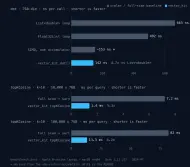
A top-10 search over 100,000 embeddings costs 82 ms per query when you score every row with a scalar cosine loop and sort the results. The same search here costs 13.3 ms: one SIMD dot product per row of a single packed buffer, row norms cached at insert time, and a bounded heap in place of the sort. Both figures come from one command on an Apple M-series laptop, 768 dimensions:
dart run bench/bench.dart


Why this instead of what you already have #
Instead of a scalar loop. The chart above comes from dart run bench/bench.dart, which is in the repo and measures both sides in one process.
A run on an Apple M-series laptop gives 647 ns per call for the List<double>
dot product against 143 ns for dot, and 84.4 ms per query for a full scan and
sort over 100,000 x 768 against 13.9 ms for VectorMatrix.topKCosine
(lib/src/vector_matrix.dart:236). Those figures move a few percent run to run.
The harness also checks that both sides return the same ten rows in the same
order, and prints the agreement count next to the timings.
Instead of ml_linalg. It is the established SIMD linear algebra package
for Dart and it is good at what it covers, including getCosine and
distanceTo(..., distance: Distance.cosine) between two vectors
(lib/vector.dart:352 and :346). Search its 6,544 lines and its README for
topk, top_k, nearest, or knn and there are no hits. Searching a matrix of
embeddings still means your own loop over every row and a sort at the end, which
is the 84.4 ms above.
Reach for it when
- You hold more than a few thousand embeddings in memory and a query has to feel instant.
- You are doing semantic search on-device, where a hosted vector index is not an option.
- You need the top k rather than one pairwise distance, and want the same answer a naive scan would give.
Skip it if you have a few hundred vectors, where a plain loop finishes in under a millisecond and the packed-buffer bookkeeping is cost with nothing behind it.
Dart has shipped SIMD types in dart:typed_data for years. Using Float32x4
well means alignment rules, scalar tails for lengths that are not a multiple of
four, accumulator ordering, and one platform trap that has its own section
below. vector_kit is that wiring as a pure Dart package with no runtime
dependencies.
Quick start #
import 'dart:typed_data';

import 'package:vector_kit/vector_kit.dart';

void main() {
  final a = Float32List.fromList([1, 0, 2, 1]);
  final b = Float32List.fromList([2, 1, 1, 0]);
  print(dot(a, b)); // 4.0
  print(cosineSimilarity(a, b)); // 0.666...
  print(euclideanDistance(a, b)); // 2.0

  // Top-k search: pack the corpus once, query many times.
  final index = VectorMatrix(768);
  for (final embedding in embeddings) {
    index.add(embedding); // Float32List of length 768
  }
  for (final (row, score) in index.topKCosine(queryEmbedding, 10)) {
    print('row $row scores $score');
  }
}
The query is any List<double>. An embedding straight out of a model goes into
topKCosine, topKDot or topKEuclidean without being wrapped in a
Float32List first.
example/vector_kit_example.dart is a short API tour.
example/semantic_search.dart is the real job: it builds a 20,000-document
index of 384-dimension vectors, searches it, and reports what it cost. That
index takes 29.3 MB as float32 and 7.6 MB once quantized to int8, with a
recall@10 of 100% on the demo's data.
Measured performance #
From bench/bench.dart on an Apple M-series laptop, Dart 3.11, JIT,
768-dimensional vectors:
| Workload | Baseline | vector_kit | Speedup |
|---|---|---|---|
| dot, 1M calls | 665 ns/call, list-of-doubles loop | 142 ns/call | 4.7x |
| dot, 1M calls | 492 ns/call, Float32List loop |
142 ns/call | 3.5x |
| topKCosine k=10, 10k rows | 7.2 ms/query, full scan and sort | 1.4 ms/query | 5.3x |
| topKCosine k=10, 100k rows | 82.0 ms/query, full scan and sort | 13.3 ms/query | 6.2x |
Compiled ahead of time (dart compile exe) the same benchmark gives
126 ns/call for dot and 1.0 / 10.5 ms/query for the two top-k workloads. The
four independent accumulators in the dot kernel are worth about 8 percent over
a single accumulator under the JIT and 14 percent compiled; the benchmark
measures both variants.
The baseline in that table scores every row and then sorts every score. A
carefully hand-written scan is a harder yardstick: cache the row norms, keep a
k-sized insertion list, and the gap narrows to 3.3x at 1000 rows of 384
dimensions. test/platform_cost_test.dart runs that version too, on all three
targets, and the numbers are in
doc/web-performance.md.
Run both on your own hardware before relying on either.
Where the top-k gain comes from: one SIMD dot product per row over a single packed buffer, L2 norms precomputed when rows are added, and a bounded min-heap instead of sorting all scores.
What is inside #
Functions over Float32List:
| Function | Notes |
|---|---|
dot(a, b) |
four Float32x4 accumulators, scalar tail |
cosineSimilarity |
clamped to [-1, 1], rejects zero vectors |
euclideanDistance |
L2 distance |
normalizeInPlace(v) |
scales v to unit norm, rejects zero vectors |
normalized(v) |
same, but returns a copy |
VectorMatrix stores rows back to back in one Float32List, padded to a
multiple of four components so every row starts on a 16-byte boundary. The
search loops read the whole matrix through a single Float32x4List view: no
per-row alignment checks, no tails.

add(row)copies the row in and caches its L2 norm.topKCosine(query, k),topKDot(query, k), andtopKEuclidean(query, k)return(index, score)records, best first. For Euclidean the score is the distance itself: smaller is better.rowAt(index)returns a live view into the storage, not a copy. Treat it as read-only; writing through it leaves the cached norm stale.toBytes()andVectorMatrix.fromBytes(bytes)serialize to a simple binary format: the ASCII magicVKT1, dimension and row count as little-endian uint32, then the float32 components in row-major order. Corrupt input throwsFormatException.
Off the Dart VM #
Float32x4 is a real SIMD type only on the Dart VM. Everywhere else the SDK
emulates it: dart2js backs it with four boxed doubles and allocates a fresh
object on every lane read, and dart2wasm's own patch file names its version
NaiveFloat32x4. Emulated SIMD runs slower than writing no SIMD at all, which
is a trap this package fell into and shipped through 1.0.4.
dart test test/platform_cost_test.dart -t bench
dart test test/platform_cost_test.dart -t bench -p chrome
dart test test/platform_cost_test.dart -t bench -p chrome -c dart2wasm

If you ship to web on 1.0.4 or earlier, upgrade. Since 1.1.0 the kernel set
is chosen at compile time from dart.library.js_interop: SIMD on the VM, plain
scalar loops elsewhere. Nothing in the public API changed. On the web the
package now costs about what the hand-written loop costs, and the packed
storage, the persistence and the int8 path all come with it.
The scalar kernels accumulate in double where the VM kernels accumulate in
float32, which puts web scores about 5e-9 away from VM scores and makes them
marginally more accurate. Ranking is asserted rather than assumed:
test/cross_platform_test.dart pins the exact top-10 rows for cosine, dot and
euclidean, and CI runs it on the VM, on dart2js and on dart2wasm.
Validation #
Every operation fails fast instead of letting a bad component poison scores
downstream: length mismatches, empty vectors, NaN or infinite components, and
zero vectors where the operation is undefined all throw ArgumentError at the
call site.
The finiteness check costs nothing on the hot path. A NaN or infinite component always drives a multiply-add accumulation non-finite, and infinities never cancel back to a finite value. Only a non-finite result triggers a rescan of the inputs to locate the exact offending component.
Precision #
Accumulation happens in Float32x4 lanes rather than in double, which puts
results a little away from an exact double-precision sum. The test suite pins
the difference to within 1e-5 relative to the product of the input norms at
dimensions up to 1024. The scalar tail (the last length % 4 components)
accumulates in double precision. Components tiny enough to underflow float32
(below about 1e-38) can therefore contribute or vanish depending on their
position; real embedding values sit many orders of magnitude above that floor.
If you need double-precision accumulation, this package is the wrong tool.
Inputs are accepted as any Float32List, including views. A view that does not
start on a 16-byte boundary is copied internally before the SIMD loop, and
normalizeInPlace still writes the result back to the original view.
int8 quantization #
When the vectors stop fitting comfortably in memory, QuantizedMatrix stores
each row as one byte per dimension plus the scale that undoes it:
final matrix = VectorMatrix.fromRows(embeddings);
final compact = QuantizedMatrix.from(matrix);

final hits = compact.topKCosine(query, 10);

benchmark/quantization_benchmark.dart, seeded, on an Apple M-series core:
| float32 | int8 | |
|---|---|---|
| memory | 14.6 MB | 3.7 MB (3.9x smaller) |
| search | 664 µs/query | 2723 µs/query (4.1x the time) |
| recall@10 | n/a | 99.3% of the float top-10 |
This buys memory and costs throughput: the byte rows cannot go through the same SIMD path the float rows do. Reach for it when the corpus is the problem rather than the latency.
Take that recall as an upper bound rather than a promise. Those are uniformly
random vectors, which sit far apart in 768 dimensions, and rounding rarely
reorders them; packing more vectors into the same space lowers it. Real
embeddings cluster, and clustered neighbours are exactly the ones eight bits
confuse. QuantizedMatrix.from leaves the source matrix untouched precisely so
you can measure recall on your own vectors before trusting it.
What this is not #
This is not a database and not an index. Every query reads every row, which is what the 13.3 ms at 100,000 x 768 buys and also what it costs: ten times the corpus is ten times the work, with no build step to amortize it against. Past the size where that hurts you want an approximate index, and on device that means objectbox, which keeps vectors in an HNSW index next to your other fields and queries them together.
What the full scan buys back is that the answer is the true top-k, with no
tuning parameter between you and it. An approximate index filtered after the
fact can return fewer rows than you asked for, because the filter runs over the
neighbours the index already picked rather than over the corpus; ObjectBox
documents that on maxResultCount, and the request to spell it out in the
vector-search guide has been
open since 2024.
Here the equivalent move is exact: topKCosine(query, matrix.rowCount) scores
and orders every row, and filtering that list afterwards still leaves you the
true top-k of whatever survives.
Missing on purpose: no metadata or filter DSL, since topK* returns row
indices and what a row means is yours to store; no isolate pool; no
Float64List path; no persistence past toBytes().
Relation to rag_kit #
rag_kit covers the retrieval pipeline (chunking, embedding orchestration, context building) and vector_kit is the numeric layer such a pipeline can sit on; neither package depends on the other today.
Planned #
Approximate nearest neighbour search (HNSW) and isolate-parallel search for very large matrices. Both stay out until the exact-search core has settled.
License #
MIT.
Metadata

Documentation
Publisher
Weekly Downloads
Metadata
SIMD-accelerated vector math for embeddings: dot product, cosine similarity, normalization, and top-k search over packed matrices.
Repository (GitHub)
View/report issues
Topics
#simd #vectors #embeddings #similarity #performance
License
 MIT (license)