
text_indexing 1.0.0  text_indexing: ^1.0.0 copied to clipboard
 gmconsult.com.au
Dart library for creating an inverted index on a collection of text documents.

Create an inverted index on a collection of text documents. #
THIS PACKAGE IS PRE-RELEASE AND SUBJECT TO DAILY BREAKING CHANGES.
Skip to section:
Overview #
This library provides interfaces and implementation classes that build and maintain a (positional, zoned) inverted index for a collection of documents or corpus (see definitions).
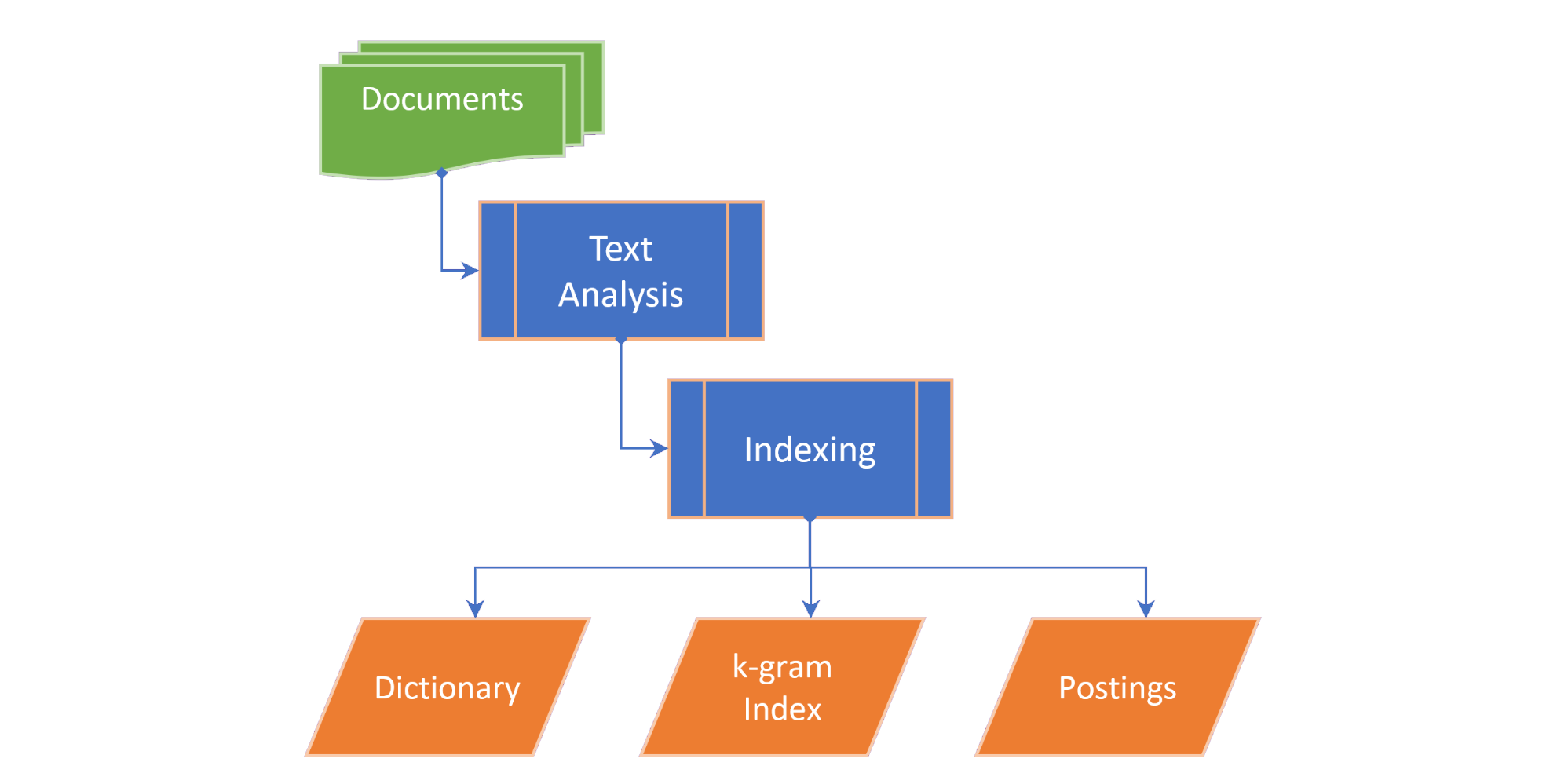
The indexer uses a tokenizer to construct three artifacts:
- the
dictionaryholds thevocabularyoftermsand the frequency of occurrence for eachtermin thecorpus; - the
k-gram indexmapsk-gramstotermsin thedictionary; - the
keyword postingsindex maps the keywords in the corpus to document references with the keyword score for the keyword in that document; and - the
postingsindex holds a list of references to thedocumentsfor eachterm(postings list). Thepostings listincludes the positions of thetermin the document'szones(fields), making thepostingsapositional, zoned inverted index.

Refer to the references to learn more about information retrieval systems and the theory behind this library.
Performance #
A sample data set consisting of stock data for the U.S. markets was used to benchmark performance of TextIndexer and InvertedIndex implementations. The data set contains 20,770 JSON documents with basic information on each stock and the JSON data file is 22MB in size.
For the benchmarking tests we created an implementation InvertedIndex class that uses Hive as local storage and benchmarked that against InMemoryIndex. Both indexes were given the same phrase length (2), k-gram length (2) and zones ('name', 'symbol', 'ticker', 'description', 'hashTag').
Benchmarking was performed as part of unit tests in the VS Code IDE on a Windows 10 workstation with an Intel(R) Core(TM) i9-7900X CPU running at 3.30GHz and 64GB of DDR4-2666 RAM.
Indexing the corpus #
The typical times taken by TextIndexer to index our sample dataset to 243,700 terms and 18,276 k-grams using InMemoryIndex vs the Hive-based index is shown below.
| InvertedIndex | Elapsed time | Per document |
|---|---|---|
| InMemoryIndex | ~15 seconds | 0.68 mS |
| Hive-based Index | ~41 minutes | 112 mS |
Building the index while holding all the index artifacts in memory is 165 times faster than placing them in a Hive box (a relatively fast local storage option).
If memory and the size of the corpus allows, InMemoryIndex is a clear winner. The memory required for the postings, in particular, may not make this practical for larger document collections. The AsyncCallbackIndex class provides the flexibility to access each of the three index hashmaps from a different data source, so implementing applications can, for example, hold the dictionary and k-gram indexes in memory, with the postings in local storage. Alternatively in-memory caching may also provide performance improvements for a corpus with many repeated terms.
Regardless of the InvertedIndex implementation, applications should avoid running the TextIndexer in the same thread as the user interface to avoid UI "jank".
The dictionary, k-gram index and postings are 8MB, 41MB and 362MB in size, respectively, for our sample index of 243,700 terms and 18,276 k-grams.
Querying the indexes #
Having created a persisted index on our sample data set, we ran a query on a search phrase of 9 terms we know are present in the sample data. The query requires a few round trips to each of the three indexes to match the terms, calculate the inverse document term frequencies etc. The elapsed time for retrieving the data from the InMemoryIndex vs the Hive-based index is shown below.
| InvertedIndex | Elapsed time |
|---|---|
| InMemoryIndex | ~22 mS |
| Hive-based Index | ~205 mS |
As expected, the InMemoryIndex is quicker than the Hive-based index, but the differences are unlikely to be material in a real-world application, even for predictive text or auto-correct applications.
Usage #
In the pubspec.yaml of your flutter project, add the text_indexing dependency.
dependencies:
  text_indexing: <latest version>
In your code file add the text_indexing import.
// import the core classes
import 'package:text_indexing/text_indexing.dart';

// import the typedefs, if needed
import 'package:text_indexing/type_definitions.dart';

// import the extensions, if needed
import 'package:text_indexing/extensions.dart';
For small collections, instantiate a TextIndexer with a InMemoryIndex, (optionally passing empty Dictionary and Postings hashmaps).
Call the TextIndexer.indexCollection method to a a collection of documents to the index.
    // initialize an in=memory index for a JSON collection with two indexed fields
    final myIndex = InMemoryIndex(
        zones: {'name': 1.0, 'description': 0.5},
        nGramRange: NGramRange(1, 2));

    // - initialize a `TextIndexer`, passing in the index
    final indexer =TextIndexer(index: myIndex);

    // - index the json collection `documents`
    await indexer.indexCollection(documents);
The examples demonstrate the use of the TextIndexer with a InMemoryIndex and AsyncCallbackIndex.
API #
The API exposes the TextIndexer interface that builds and maintains an InvertedIndex for a collection of documents.
To maximise performance of the indexers the API performs lookups in nested hashmaps of DART core types.
The API contains a fair amount of boiler-plate, but we aim to make the code as readable, extendable and re-usable as possible:
- We use an
interface > implementation mixin > base-class > implementation class pattern:- the
interfaceis an abstract class that exposes fields and methods but contains no implementation code. Theinterfacemay expose a factory constructor that returns animplementation classinstance; - the
implementation mixinimplements theinterfaceclass methods, but not the input fields; - the
base-classis an abstract class with theimplementation mixinand exposes a default, unnamed generative const constructor for sub-classes. The intention is thatimplementation classesextend thebase class, overriding theinterfaceinput fields with final properties passed in via a const generative constructor; and - the class naming convention for this pattern is
"Interface" > "InterfaceMixin" > "InterfaceBase".
- the
- To improve code legibility the API makes use of type aliases, callback function definitions and extensions. The typedefs and extensions are not exported by the text_indexing library, but can be found in the type_definitions and extensions mini-libraries. Import these libraries seperately if needed.
InvertedIndex #
The InvertedIndex interface exposes properties and methods for working with Dictionary, KGramIndex and Postings hashmaps.
Two implementation classes are provided:
- the InMemoryIndex class is intended for fast indexing of a smaller corpus using in-memory dictionary, k-gram and postings hashmaps; and
- the AsyncCallbackIndex is intended for working with a larger corpus. It uses asynchronous callbacks to perform read and write operations on
dictionary,k-gramandpostingsrepositories.
N-Gram Range
InvertedIndex.nGramRange is the range of N-gram lengths to generate. The minimum n-gram length is 1.
If n-gram length is greater than 1, the index vocabulary also contains n-grams up to nGramRange.max long, concatenated from consecutive terms. The index size is increased by a factor of[nGramRange.max. The nGramRange default is NGramRange(1,2) for InMemoryIndex and AsyncCallbackIndex.
Zones
InvertedIndex.zones is a hashmap of zone names to their relative weight in the index.
If zones is empty, all the text fields of the collection will be indexed, which may increase the size of the index significantly.
K-gram length (k)
InvertedIndex.k is the length of k-gram entries in the k-gram index.
The preferred k-gram length is 3, or a tri-gram. This results in a good compromise between the length of the k-gram index and search efficiency.
TextIndexer #
TextIndexer is an interface for classes that construct and maintain a InvertedIndex.
Text or documents can be indexed by calling the following methods:
- indexText indexes text;
- indexJson indexes the fields in a
JSONdocument; and - indexCollection indexes the fields of all the documents in a JSON document collection.
Definitions #
The following definitions are used throughout the documentation:
corpus- the collection ofdocumentsfor which anindexis maintained.cosine similarity- similarity of two vectors measured as the cosine of the angle between them, that is, the dot product of the vectors divided by the product of their euclidian lengths (from Wikipedia).character filter- filters characters from text in preparation of tokenization .Damerau–Levenshtein distance- a metric for measuring theedit distancebetween twotermsby counting the minimum number of operations (insertions, deletions or substitutions of a single character, or transposition of two adjacent characters) required to change oneterminto the other (from Wikipedia).dictionary (in an index)- a hash ofterms(vocabulary) to the frequency of occurence in thecorpusdocuments.document- a record in thecorpus, that has a unique identifier (docId) in thecorpus's primary key and that contains one or more text fields that are indexed.document frequency (dFt)- the number of documents in thecorpusthat contain a term.edit distance- a measure of how dissimilar two terms are by counting the minimum number of operations required to transform one string into the other (from Wikipedia).etymology- the study of the history of the form of words and, by extension, the origin and evolution of their semantic meaning across time (from Wikipedia).Flesch reading ease score- a readibility measure calculated from sentence length and word length on a 100-point scale. The higher the score, the easier it is to understand the document (from Wikipedia).Flesch-Kincaid grade level- a readibility measure relative to U.S. school grade level. It is also calculated from sentence length and word length (from Wikipedia).IETF language tag- a standardized code or tag that is used to identify human languages in the Internet. (from Wikepedia).index- an inverted index used to look updocumentreferences from thecorpusagainst avocabularyofterms.index-elimination- selecting a subset of the entries in an index where thetermis in the collection oftermsin a search phrase.inverse document frequency (iDft)- a normalized measure of how rare atermis in the corpus. It is defined aslog (N / dft), where N is the total number of terms in the index. TheiDftof a rare term is high, whereas theiDftof a frequent term is likely to be low.Jaccard indexmeasures similarity between finite sample sets, and is defined as the size of the intersection divided by the size of the union of the sample sets (from Wikipedia).Map<String, dynamic>is an acronym for"Java Script Object Notation", a common format for persisting data.k-gram- a sequence of (any) k consecutive characters from aterm. Ak-gramcan start with "$", denoting the start of the term, and end with "$", denoting the end of the term. The 3-grams for "castle" are { $ca, cas, ast, stl, tle, le$ }.lemma or lemmatizer- lemmatisation (or lemmatization) in linguistics is the process of grouping together the inflected forms of a word so they can be analysed as a single item, identified by the word's lemma, or dictionary form (from Wikipedia).n-gram(sometimes also called Q-gram) is a contiguous sequence ofnitems from a given sample of text or speech. The items can be phonemes, syllables, letters, words or base pairs according to the application. Then-gramstypically are collected from a text or speechcorpus. When the items are words,n-gramsmay also be called shingles (from Wikipedia).Natural language processing (NLP)is a subfield of linguistics, computer science, and artificial intelligence concerned with the interactions between computers and human language, in particular how to program computers to process and analyze large amounts of natural language data (from Wikipedia).Part-of-Speech (PoS) taggingis the task of labelling every word in a sequence of words with a tag indicating what lexical syntactic category it assumes in the given sequence (from Wikipedia).Phonetic transcription- the visual representation of speech sounds (or phones) by means of symbols. The most common type of phonetic transcription uses a phonetic alphabet, such as the International Phonetic Alphabet (from Wikipedia).postings- a separate index that records whichdocumentsthevocabularyoccurs in. In a positionalindex, the postings also records the positions of eachtermin thetextto create a positional invertedindex.postings list- a record of the positions of atermin adocument. A position of atermrefers to the index of thetermin an array that contains all thetermsin thetext. In a zonedindex, thepostings listsrecords the positions of eachtermin thetextazone.stem or stemmer- stemming is the process of reducing inflected (or sometimes derived) words to their word stem, base or root form (generally a written word form) (from Wikipedia).stopwords- common words in a language that are excluded from indexing.term- a word or phrase that is indexed from thecorpus. Thetermmay differ from the actual word used in the corpus depending on thetokenizerused.term filter- filters unwanted terms from a collection of terms (e.g. stopwords), breaks compound terms into separate terms and / or manipulates terms by invoking astemmerand / orlemmatizer.term expansion- finding terms with similar spelling (e.g. spelling correction) or synonyms for a term.term frequency (Ft)- the frequency of atermin an index or indexed object.term position- the zero-based index of atermin an ordered array oftermstokenized from thecorpus.text- the indexable content of adocument.token- representation of atermin a text source returned by atokenizer. The token may include information about thetermsuch as its position(s) (term position) in the text or frequency of occurrence (term frequency).token filter- returns a subset oftokensfrom the tokenizer output.tokenizer- a function that returns a collection oftokens fromtext, after applying a character filter,termfilter, stemmer and / or lemmatizer.vocabulary- the collection oftermsindexed from thecorpus.zone- the field or zone of a document that a term occurs in, used for parametric indexes or where scoring and ranking of search results attribute a higher score to documents that contain a term in a specific zone (e.g. the title rather that the body of a document).
References #
- Manning, Raghavan and Schütze, "Introduction to Information Retrieval", Cambridge University Press, 2008
- University of Cambridge, 2016 "Information Retrieval", course notes, Dr Ronan Cummins, 2016
- Wikipedia (1), "Inverted Index", from Wikipedia, the free encyclopedia
- Wikipedia (2), "Lemmatisation", from Wikipedia, the free encyclopedia
- Wikipedia (3), "Stemming", from Wikipedia, the free encyclopedia
- Wikipedia (4), "Synonym", from Wikipedia, the free encyclopedia
- Wikipedia (5), "Jaccard Index", from Wikipedia, the free encyclopedia
- Wikipedia (6), "Flesch–Kincaid readability tests", from Wikipedia, the free encyclopedia
- Wikipedia (7), "Edit distance", from Wikipedia, the free encyclopedia
- Wikipedia (8), "Damerau–Levenshtein distance", from Wikipedia, the free encyclopedia
- Wikipedia (9), "Natural language processing", from Wikipedia, the free encyclopedia
- Wikipedia (10), "IETF language tag", from Wikipedia, the free encyclopedia
- Wikipedia (11), "Phonetic transcription", from Wikipedia, the free encyclopedia
- Wikipedia (12), "Etymology", from Wikipedia, the free encyclopedia
- Wikipedia (13), "Part-of-speech tagging", from Wikipedia, the free encyclopedia
- Wikipedia (14), "N-gram", from Wikipedia, the free encyclopedia
- Wikipedia (15), "Cosine similarity", from Wikipedia, the free encyclopedia
Issues #
If you find a bug please fill an issue.
This project is a supporting package for a revenue project that has priority call on resources, so please be patient if we don't respond immediately to issues or pull requests.
Metadata
Publisher
Weekly Downloads
Metadata
Dart library for creating an inverted index on a collection of text documents.
Homepage
Repository (GitHub)
View/report issues
Documentation
License
 BSD-3-Clause (license)
Dependencies
collection, meta, rxdart, text_analysis

