
share_receiver 1.0.2  share_receiver: ^1.0.2 copied to clipboard
 mrrhak.com
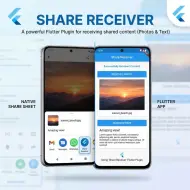
A Flutter plugin for iOS and Android to handle incoming shared text or media from other apps.
🌿 Share Receiver 🌿
A powerful and easy-to-use Flutter plugin that enables your iOS and Android apps to seamlessly receive and handle shared text, images, videos, and files from other applications using native share sheets.


Guide #
Installation #
Add share_receiver as a dependency in your pubspec.yaml file:
flutter pub add share_receiver
Configuration #
Android
- Edit your Android Manifest file, located in
android/app/src/main/AndroidManifest.xmland add/uncomment the intent filters and meta data that you want to support:
<manifest xmlns:android="http://schemas.android.com/apk/res/android">
    <application
        android:label="share_receiver_example"
        android:name="${applicationName}"
        android:icon="@mipmap/ic_launcher">
        <activity
            android:name=".MainActivity"
            android:exported="true"
            android:launchMode="singleTop"
            android:taskAffinity=""
            android:theme="@style/LaunchTheme"
            android:configChanges="orientation|keyboardHidden|keyboard|screenSize|smallestScreenSize|locale|layoutDirection|fontScale|screenLayout|density|uiMode"
            android:hardwareAccelerated="true"
            android:windowSoftInputMode="adjustResize">
            <!-- ... -->

            <!-- Intent filters for share functionality -->
            <!--TODO: Add this filter if you want to handle shared text-->
            <intent-filter>
                <action android:name="android.intent.action.SEND" />
                <category android:name="android.intent.category.DEFAULT" />
                <data android:mimeType="text/*" />
            </intent-filter>

            <!--TODO: Add this filter if you want to handle shared images-->
            <intent-filter>
                <action android:name="android.intent.action.SEND" />
                <category android:name="android.intent.category.DEFAULT" />
                <data android:mimeType="image/*" />
            </intent-filter>

            <intent-filter>
                <action android:name="android.intent.action.SEND_MULTIPLE" />
                <category android:name="android.intent.category.DEFAULT" />
                <data android:mimeType="image/*" />
            </intent-filter>

            <!--TODO: Add this filter if you want to handle shared videos-->
            <intent-filter>
                <action android:name="android.intent.action.SEND" />
                <category android:name="android.intent.category.DEFAULT" />
                <data android:mimeType="video/*" />
            </intent-filter>
            <intent-filter>
                <action android:name="android.intent.action.SEND_MULTIPLE" />
                <category android:name="android.intent.category.DEFAULT" />
                <data android:mimeType="video/*" />
            </intent-filter>

            <!--TODO: Add this filter if you want to handle any type of file-->
            <intent-filter>
                <action android:name="android.intent.action.SEND" />
                <category android:name="android.intent.category.DEFAULT" />
                <data android:mimeType="*/*" />
            </intent-filter>
            <intent-filter>
                <action android:name="android.intent.action.SEND_MULTIPLE" />
                <category android:name="android.intent.category.DEFAULT" />
                <data android:mimeType="*/*" />
            </intent-filter>
        </activity>
        <!-- ... -->
    </application>
    <!-- ... -->
</manifest>
Note
If you want to prevent incoming shares from opening a new activity each time, add/edit the attribute android:launchMode="singleTask" to your MainActivity intent inside your AndroidManifest.xml file.
iOS
- Edit your iOS Info.plist file, located in
ios/Runner/Info.plist. It registers your app to open via a deep link that will be launched from the Share Extension.
<!-- Uncomment below lines if you want to use a custom group id rather than the default. Set it in Build Settings → User-Defined -->
<!-- <key>AppGroupId</key>
<string>$(CUSTOM_GROUP_ID)</string> -->
<key>CFBundleURLTypes</key>
<array>
    <dict>
        <key>CFBundleTypeRole</key>
        <string>Editor</string>
        <key>CFBundleURLSchemes</key>
        <array>
            <string>ShareMedia-$(PRODUCT_BUNDLE_IDENTIFIER)</string>
        </array>
    </dict>
</array>
-
Create Share Extension
- In Xcode, go to the menu and select File → New → Target → choose Share Extension
- Give it the name
ShareExtensionand save
-
Go to Build Phases of your
Runnertarget and moveEmbed Foundation Extensionto the top ofThin Binary. -
Make the following edits to
ios/ShareExtension/Info.plist
<?xml version="1.0" encoding="UTF-8"?>
<!DOCTYPE plist PUBLIC "-//Apple//DTD PLIST 1.0//EN" "http://www.apple.com/DTDs/PropertyList-1.0.dtd">
<plist version="1.0">
<dict>
    <!-- Uncomment below lines if you want to use a custom group id rather than the default. Set it in Build Settings → User-Defined -->
    <!-- <key>AppGroupId</key>
    <string>$(CUSTOM_GROUP_ID)</string> -->
    <key>NSExtension</key>
    <dict>
        <key>NSExtensionAttributes</key>
        <dict>
            <key>NSExtensionActivationRule</key>
            <!-- The TRUEPREDICATE NSExtensionActivationRule that only works in development mode -->
            <!-- <string>TRUEPREDICATE</string> -->
            <!-- Add a new rule below will allow sharing one or more file of any type, url, or text content. -->
            <!-- You can modify these rules to your liking for which types of share content your app can handle. -->
            <string>SUBQUERY (
                extensionItems,
                $extensionItem,
                SUBQUERY (
                    $extensionItem.attachments,
                    $attachment,
                    (
                        ANY $attachment.registeredTypeIdentifiers UTI-CONFORMS-TO "public.file-url"
                        || ANY $attachment.registeredTypeIdentifiers UTI-CONFORMS-TO "public.image"
                        || ANY $attachment.registeredTypeIdentifiers UTI-CONFORMS-TO "public.text"
                        || ANY $attachment.registeredTypeIdentifiers UTI-CONFORMS-TO "public.movie"
                        || ANY $attachment.registeredTypeIdentifiers UTI-CONFORMS-TO "public.url"
                    )
                ).@count > 0
            ).@count > 0
            </string>
            <key>PHSupportedMediaTypes</key>
            <array>
                <string>Video</string>
                <string>Image</string>
            </array>
        </dict>
        <key>NSExtensionMainStoryboard</key>
        <string>MainInterface</string>
        <key>NSExtensionPointIdentifier</key>
        <string>com.apple.share-services</string>
    </dict>
</dict>
</plist>
-
Add a group identifier to both the
RunnerandShareExtensiontargets- In Xcode, select Runner → Targets → Runner → Signing & Capabilities
- Click + and select App Groups
- Add a new group (default: your bundle identifier prefixed with
group., e.g.group.com.company.app) - Repeat those steps inside the ShareExtension target using the same group id
-
(Optional) If you used a custom group identifier that isn't your bundle identifier prefixed by
group., add a custom build setting in both targets:- Go to Targets → ShareExtension → Build Settings
- Click + → Add User-Defined Setting
- Key:
CUSTOM_GROUP_ID, Value: your app group identifier - Repeat for the Runner target
-
Wire up the Share Extension view controller
The Share Extension serializes the shared content and saves it to the shared container, then opens a deep link back into the main app. The extension itself is lightweight — it does not embed Flutter.
Important
The Share Extension must not link
FlutterGeneratedPluginSwiftPackage. That package pulls in the Flutter framework, which is too large for an extension. Useshare-receiver-models(SPM) orshare_receiver_models(CocoaPods) instead — both are Flutter-free.
Swift Package Manager
The
share_receiverpackage exposes a lightweightshare-receiver-modelsproduct that contains only the extension-safe code (no Flutter dependency).Step 1 — Add
share-receiver-modelsto your Share Extension target in Xcode:- Select your ShareExtension target → General → Frameworks and Libraries
- Click +, search for
share-receiver-modelsand add it
If
share-receiver-modelsdoes not appear in the list:- Go to File → Add Package Dependencies → Add Local
- Navigate to
ios/Flutter/ephemeral/Packages/.packages/share_receiver/ - When prompted to choose products, add only
share-receiver-modelsto the ShareExtension target (do not addshare-receiveror add anything to the Runner target)
Step 2 — Verify the Share Extension does not link
FlutterGeneratedPluginSwiftPackage:- Select your ShareExtension target → General → Frameworks and Libraries
- If
FlutterGeneratedPluginSwiftPackageis listed, remove it
Step 3 — Replace
ShareExtension/ShareViewController.swift:import share_receiver_models class ShareViewController: ShareReceiverServiceViewController {}
CocoaPods
Option 1 — Lightweight (recommended):
share_receiver_modelspod (no Flutter dependency)Add the following inside
ios/Podfilewithin thetarget 'Runner' doblock, then runpod installinside theiosdirectory.target 'Runner' do use_frameworks! use_modular_headers! flutter_install_all_ios_pods File.dirname(File.realpath(__FILE__)) # share_receiver start target 'ShareExtension' do inherit! :search_paths pod 'share_receiver_models', :path => '.symlinks/plugins/share_receiver/ios/share_receiver' end # share_receiver end endReplace
ShareExtension/ShareViewController.swiftwith:import share_receiver_models class ShareViewController: ShareReceiverServiceViewController {}Option 2 — Full pod (
share_receiver) with Flutter dependencyNote
This option links the Flutter framework into the Share Extension, which increases the extension binary size significantly. Prefer Option 1 unless you have a specific reason to use this approach.
target 'Runner' do
  use_frameworks!
  use_modular_headers!

  flutter_install_all_ios_pods File.dirname(File.realpath(__FILE__))

  # share_receiver start
  target 'ShareExtension' do
    inherit! :search_paths
  end
  # share_receiver end
end
Replace
ShareExtension/ShareViewController.swiftwith:import share_receiver class ShareViewController: ShareReceiverServiceViewController {}Make sure the Xcode scheme has a Pre-Action Script so Flutter is available before the build:
- Xcode → Product → Scheme → Edit Scheme → Build → Pre-action → Add Run Script
/bin/sh "$FLUTTER_ROOT/packages/flutter_tools/bin/xcode_backend.sh" prepare
Example #
import 'package:flutter/material.dart';
import 'package:share_receiver/share_receiver.dart';

void main() {
  runApp(const MyApp());
}

class MyApp extends StatefulWidget {
  const MyApp({super.key});

  @override
  State<MyApp> createState() => _MyAppState();
}

class _MyAppState extends State<MyApp> {
  SharedData? _sharedData;

  @override
  void initState() {
    super.initState();
    _initShareReceiver();
  }

  @override
  void dispose() {
    ShareReceiver.instance.dispose();
    super.dispose();
  }

  Future<void> _initShareReceiver() async {
    // Get initial sharing data (if app was opened via share)
    final initial = await ShareReceiver.instance.getInitialSharing();
    if (initial != null) {
      print('Received initial share data: $initial');
      setState(() => _sharedData = initial);
      // Clear the initial data
      ShareReceiver.instance.clear();
    }

    // Listen for shares while app is running
    ShareReceiver.instance.getMediaStream().listen((data) {
      print('Received share data: $data');
      setState(() => _sharedData = data);
      // Clear the received data
      ShareReceiver.instance.clear();
    });
  }

  @override
  Widget build(BuildContext context) {
    return MaterialApp(
      home: Scaffold(
        appBar: AppBar(title: const Text('Share Receiver Example')),
        body: Padding(
          padding: const EdgeInsets.all(16.0),
          child: Center(
            child: Column(
              mainAxisSize: .min,
              spacing: 8.0,
              children: [
                Text('Shared data: ${_sharedData?.toString() ?? 'No data'}'),
              ],
            ),
          ),
        ),
      ),
    );
  }
}
See the example here for runnable project of various usages.
Bugs or Requests #
If you encounter any problems feel free to open an issue. If you feel the library is missing a feature, please raise a ticket on GitHub and I'll look into it. Pull request are also welcome.
See Contributing.md.
Support #
Don't forget to give it a like 👍 or a star ⭐
Activities #

Metadata

Documentation
Publisher
Weekly Downloads
Metadata
A Flutter plugin for iOS and Android to handle incoming shared text or media from other apps.
Homepage
Repository (GitHub)
View/report issues
Contributing
Topics
#share-receiver #share-handler #share-intent #share-extension
Funding
Consider supporting this project:
ko-fi.com
License
 MIT (license)
Dependencies
flutter, plugin_platform_interface
More
Packages that depend on share_receiver
Packages that implement share_receiver