
precise_compass 0.1.0  precise_compass: ^0.1.0 copied to clipboard
 awrs.me
Honest, high-accuracy Flutter compass: continuous heading accuracy in degrees, confidence scoring, sensor fusion, and reliable calibration detection.
precise_compass #


An honest, high-accuracy Flutter compass. Every reading carries a
continuous heading-uncertainty estimate in degrees, a 0..1 confidence score,
debounced calibration detection, sensor fusion, and graceful degradation — so
your app never has to lie to its users about how good the heading is.
The one-sentence difference: other compass packages report a coarse, sticky 3-level "accuracy" derived from Android's
onAccuracyChangedstatus.precise_compassreports the OS-provided continuous heading accuracy (TYPE_ROTATION_VECTOR.values[4]on Android,CLHeading.headingAccuracyon iOS), cross-checks it against the magnetic-field magnitude to catch interference the status misses, and folds everything into one trustworthyconfidencevalue and a non-flickeringshouldCalibrateflag.


Why it exists #
Compass headings are only useful if you know when not to trust them — qibla finders, AR overlays, navigation and surveying all break silently when the magnetometer is uncalibrated or sitting next to a speaker magnet. The popular packages can't tell you this reliably:
precise_compass |
flutter_compass / _v2 |
compassx |
flutter_device_compass |
|
|---|---|---|---|---|
| Continuous accuracy (degrees) | ✅ values[4] / headingAccuracy |
❌ status→15/30/45 buckets |
⚠️ undocumented | ❌ none |
Confidence score (0..1) |
✅ | ❌ | ❌ | ❌ |
| Magnetic-interference detection | ✅ field magnitude | ❌ | ❌ | ❌ |
Debounced shouldCalibrate |
✅ hysteresis FSM | ❌ | ⚠️ undocumented | ❌ |
| Sensor-fusion modes | ✅ RV / geomagnetic / manual | ⚠️ RV + fallback | RV | RV |
| Capability introspection | ✅ | ❌ | ❌ | ❌ |
| Full-orientation heading | ✅ | ✅ (v2) | ❌ portrait-only | ⚠️ |
| Pure-Dart, unit-tested core | ✅ ≥90% | ❌ | ❌ | ❌ |
Quick start #
import 'package:precise_compass/precise_compass.dart';

final subscription = PreciseCompass.heading.listen((reading) {
  if (!reading.hasHeading) return; // no compass on this device

  print('${reading.heading.toStringAsFixed(0)}° '
      '± ${reading.accuracyDegrees.toStringAsFixed(0)}° '
      '· ${(reading.confidence * 100).toStringAsFixed(0)}% confident');

  if (reading.shouldCalibrate) {
    // Prompt a figure-8 motion, or let iOS show its native HUD.
  }
});

// Sensors register lazily on first listen and release on cancel:
await subscription.cancel();
What a reading tells you #
class CompassReading {
  final double? headingMagnetic;        // degrees [0,360) or null
  final double? headingTrue;            // degrees [0,360) or null (needs location)
  final double  heading;                // true if available, else magnetic
  final double  accuracyDegrees;        // continuous ± estimate; -1 = unknown
  final CompassAccuracy accuracy;       // high / medium / low / unreliable / unknown
  final double  confidence;             // 0.0 … 1.0
  final bool    shouldCalibrate;        // debounced recommendation
  final CalibrationStatus calibrationStatus;
  final HeadingSource source;           // rotationVector / geomagnetic / fusion / …
  final double? magneticFieldMagnitude; // µT (Earth ≈ 25–65 µT)
  final double? pitch, roll;            // degrees, for AR
  final DateTime timestamp;
}
It never throws for a missing sensor: you get source: unavailable,
accuracy: unknown, confidence: 0 instead.
Configuration #
PreciseCompass.headingStream(
  config: const CompassConfig(
    reference: HeadingReference.auto,     // trueNorth / magnetic / auto
    fusionMode: FusionMode.auto,          // rotationVector / geomagnetic / fusion / auto
    rate: SensorRate.ui,                  // fastest / ui / normal / batterySaving
    smoothingFactor: null,                // null = light default; 0 = off; →1 = smoother
    detectCalibration: true,
    suppressIosCalibrationHud: false,     // true = hide native HUD, show your own
    magneticFieldBand: ClampRange(25, 65),
  ),
).listen(...);
Probe the hardware before offering features:
final caps = await PreciseCompass.capabilities();
if (caps.supportsTrueHeading) enableTrueNorthToggle();
print('Recommended mode: ${caps.recommendedMode}');
Platform setup #
Android #
No permission is needed for magnetic heading. For true heading the plugin reads the device's last known location to compute declination, so the host app must declare and request a location permission:
<!-- android/app/src/main/AndroidManifest.xml -->
<uses-permission android:name="android.permission.ACCESS_COARSE_LOCATION" />
Minimum SDK: 21.
iOS #
Add a usage string so the system can provide true heading (location):
<!-- ios/Runner/Info.plist -->
<key>NSLocationWhenInUseUsageDescription</key>
<string>Used to show your true (geographic) heading.</string>
Minimum iOS: 12. The compass is unavailable on the iOS Simulator.
How accuracy & calibration work #
- Continuous accuracy. Android exposes the OS estimate as
TYPE_ROTATION_VECTOR.values[4](radians); iOS asCLHeading.headingAccuracy(degrees). We convert to a singleaccuracyDegrees(-1when the OS provides no estimate) and bucket it intoCompassAccuracy(≤10° high,≤20° medium,≤45° low, elseunreliable). - Interference detection. Earth's field is ≈25–65 µT. A magnitude well
outside the configured band — even when the OS still claims "high" — drives the
field score and
shouldCalibratedown. This catches the most common real-world failure that status-based compasses miss. - Confidence. A documented, monotonic blend of accuracy and short-term
heading stability, gated by source quality and field health, in
[0,1]. The exact formula is inARCHITECTURE.md. - Debounced calibration. A hysteresis state machine asserts
shouldCalibrateonly after ~1.5 s of sustained poor quality and clears it only after ~1 s of sustained good quality — no flicker, and no cold-start false positive.
See ARCHITECTURE.md for the data-flow diagram, the confidence formula, the fusion math and the calibration FSM.
Migrating #
Coming from flutter_compass, flutter_compass_v2 or compassx? See
MIGRATION.md for API mapping tables.
Example #
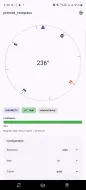
The example/ app is a live test harness: a rotating dial, numeric
heading, accuracy/confidence meters, a figure-8 calibration banner, a capability
readout, and toggles for reference/rate/fusion mode.
Attribution & license #
precise_compass is MIT-licensed. It originated as a fork of
flutter_compass_v2 (itself a
fork of flutter_compass by
Hemanth Raj V), both MIT. The native Android orientation/math code was
rewritten from scratch to keep the entire package MIT-clean. See
LICENSE.
Metadata

Documentation
Publisher
Weekly Downloads
Metadata
Honest, high-accuracy Flutter compass: continuous heading accuracy in degrees, confidence scoring, sensor fusion, and reliable calibration detection.
Repository (GitHub)
View/report issues
Contributing
Topics
#compass #sensors #heading #navigation #location
License
 MIT (license)
Dependencies
More
Packages that depend on precise_compass
Packages that implement precise_compass