
nts 10.0.1  nts: ^10.0.1 copied to clipboard
 nllewellyn.com
Authenticated network time for Flutter apps, secured by Network Time Security (NTS).
nts — minimal usage snippet #
The smallest end-to-end use of package:nts: a warm-then-burst flow
against time.cloudflare.com over RFC 8915 NTS-KE that picks the
lowest-RTT sample and applies symmetric-path delay compensation, with
an exhaustive switch on every NtsError variant.
ntsQuery deliberately returns the raw protocol primitives (server
transmit timestamp + measured RTT) rather than a finished synchronized
clock; this snippet shows the minimum filtering and offset correction
a production caller needs when composing the primitives by hand. Most
callers can skip all of it and use the one-call ntsGetTime
convenience instead — see the README's "Quick start" and "Manual
control (advanced primitives)" sections for the rationale.
The same code ships as a runnable Flutter target at
example/main.dart.
// Minimal `package:nts` usage example — a warm-then-burst flow against
// `time.cloudflare.com` over RFC 8915. Phase 1 fills the per-host cookie
// jar with a fresh NTS-KE handshake; phase 2 spends every cookie the
// server delivered on authenticated NTPv4 exchanges, picks the
// lowest-RTT reply, and applies the standard symmetric-path delay
// correction to recover the server's clock at the moment the chosen
// reply arrived.
//
// `ntsQuery` returns the raw protocol primitives — server transmit
// timestamp plus measured round-trip time — not a finished synchronized
// clock. The burst-and-pick pattern below is the minimum a production
// caller needs on top to get a stable offset; the one-call `ntsGetTime`
// convenience automates this recipe (selecting on the RFC 5905 peer
// delay each sample also carries, which additionally excludes server
// processing time). See `README.md`'s "Manual control (advanced
// primitives)" section for the full rationale.
//
// Run from a Flutter target (`flutter run -t example/main.dart`)
// so the Native Assets pipeline bundles the Rust dylib into the app.
// `dart run` also runs the build hook (Dart 3.10+), but the bridge's
// default loader does not load the library it builds; see
// `example/bin/nts_cli.dart` for the explicit `ExternalLibrary.open`
// loader pattern needed there.

// ignore_for_file: avoid_print

import 'package:nts/nts.dart';

Future<void> main() async {
  // Bridge bootstrap. Resolves the bundled `libnts_rust.{dylib|so|dll}`
  // through the stable Native Assets API and wires the FRB dispatch
  // table. Must be awaited before any nts* entry point; repeated and
  // concurrent calls converge on the first rather than re-initializing.
  await NtsBridge.ensureInitialized();

  // RFC 8915 NTS-KE endpoint. Port 4460 is the IANA-assigned default;
  // any host listed at <https://github.com/jauderho/nts-servers> works.
  const spec = NtsServerSpec(host: 'time.cloudflare.com', port: 4460);

  try {
    // Phase 1 — warm the cookie jar. Forces a fresh TLS 1.3 NTS-KE
    // handshake against `spec`, ingests the delivered cookie pool, and
    // returns an `NtsWarmCookiesOutcome` whose `freshCookies` field
    // reports how many cookies the server handed out alongside a
    // `phaseTimings` breakdown of the handshake's wall-clock cost.
    // RFC 8915 §4 leaves that count to server policy, so the burst
    // below is sized off this return value rather than any fixed
    // constant. Replaces any cached session for that `spec`, so
    // subsequent `ntsQuery` calls skip the KE leg until the jar
    // drains. Useful at startup or whenever the NTS-KE cost should be
    // amortized away from a time-critical path. `timeout` and
    // `dnsConcurrencyCap` are omitted here so the package's tuned
    // defaults (`kDefaultTimeout`, `kDefaultDnsConcurrencyCap`)
    // apply; `bridgeConcurrencyCap` is passed explicitly (at its
    // default value) to surface the Dart-side admission gate that
    // bounds how many of the package's calls occupy
    // `flutter_rust_bridge` worker threads at once.
    final warmed = await ntsWarmCookies(
      spec: spec,
      bridgeConcurrencyCap: kDefaultBridgeConcurrencyCap,
    );
    print('warmed   = ${warmed.freshCookies} cookies');

    // Phase 2 — spend the warmed cookies on authenticated NTPv4
    // exchanges. Each `ntsQuery` reuses the warmed AEAD keys, so the
    // steady-state cost is one UDP round-trip per call. Collect every
    // sample so we can score them against each other below.
    final samples = <NtsTimeSample>[];
    for (var i = 0; i < warmed.freshCookies; i++) {
      samples.add(
        await ntsQuery(
          spec: spec,
          bridgeConcurrencyCap: kDefaultBridgeConcurrencyCap,
        ),
      );
    }

    // Pick the sample with the smallest measured round-trip. NTP's
    // symmetric-path assumption is most accurate when the path is
    // shortest, so the lowest-RTT reply yields the smallest residual
    // offset error after compensation. This is the basic statistical
    // filter every production NTP/NTS client implements; more
    // sophisticated callers can also weight by stratum or run Marzullo's
    // algorithm across multiple servers.
    final best = samples.reduce(
      (a, b) => a.roundTripMicros <= b.roundTripMicros ? a : b,
    );

    // Apply the standard symmetric-path correction: assume the one-way
    // delay is half the round-trip, so the server's clock at the moment
    // its reply landed locally is `utc_unix_micros + rtt / 2`. The
    // package returns the raw server transmit timestamp on purpose;
    // applying this offset is the caller's responsibility because the
    // "right" filter (median, lowest-RTT, Marzullo, …) is workload
    // specific.
    final adjustedMicros = best.utcUnixMicros + (best.roundTripMicros ~/ 2);
    final adjustedUtc = DateTime.fromMicrosecondsSinceEpoch(
      adjustedMicros,
      isUtc: true,
    );
    final rttMs = best.roundTripMicros / 1000.0;

    print('samples  = ${samples.length}');
    print('best-rtt = ${rttMs.toStringAsFixed(2)} ms');
    print('utc      = ${adjustedUtc.toIso8601String()}  (RTT/2-compensated)');
    print('stratum  = ${best.serverStratum}');
    print('aead-id  = ${best.aeadId}');
    print('cookies  = ${best.freshCookies}');
  } on NtsError catch (err) {
    // `NtsError` is a Dart 3 sealed class — exhaustive switch
    // expressions catch new variants at compile time if the package
    // ever grows them. Both `ntsWarmCookies` and `ntsQuery` surface
    // failures through this same hierarchy.
    final detail = switch (err) {
      NtsErrorInvalidSpec(:final message) => 'invalid spec: $message',
      NtsErrorNetwork(:final message) => 'network: $message',
      NtsErrorKeProtocol(:final message) => 'NTS-KE: $message',
      NtsErrorNtpProtocol(:final message) => 'NTP: $message',
      NtsErrorAuthentication(:final message) => 'AEAD auth: $message',
      NtsErrorTimeout(:final phase) => 'timeout in phase ${phase.name}',
      NtsErrorNoCookies() => 'no cookies returned',
      NtsErrorTrustBackendUnavailable(:final message) =>
        'trust backend unavailable: $message',
      NtsErrorInternal(:final message) => 'internal: $message',
      NtsErrorAbiMismatch(:final message) => 'ABI mismatch: $message',
      NtsErrorClockFault(:final stage, :final fault) =>
        'clock fault in stage ${stage.name}: ${fault.message}',
    };
    print('nts call failed: $detail');
  }
}
Strict clock #
New in 10.0. The strict path fails closed instead of falling back to a clock it cannot attribute. This snippet uses it locally, with no boot identity, and shows that same-boot transfer is refused: the package approves no boot-scope provider in this release, so an app-written one is rejected before it is consulted. It does not persist anything; authenticating and storing a reference is the consumer's job.
// ignore_for_file: avoid_print

import 'package:nts/nts.dart';

/// A provider the app wrote itself. Providers are approved by
/// instance through `kApprovedBootScopeProviders`, which ships empty.
final class AppBootScopeProvider implements BootScopeProvider {
  const AppBootScopeProvider();

  @override
  String get providerId => 'com.example.boot-scope';

  @override
  Future<BootScope?> current() async => null;
}

Future<void> main() async {
  await NtsBridge.ensureInitialized();

  final StrictClockContext clock;
  try {
    clock = StrictClockContext.resolve();
  } on StrictClockError catch (e) {
    // Fail closed: no MonotonicClock or DateTime.now() substitute.
    print('strict clock unavailable: $e');
    return;
  }

  const spec = NtsServerSpec(host: 'time.cloudflare.com', port: 4460);
  final StrictSyncedTime synced;
  try {
    synced = await ntsGetTimeStrict(spec: spec, context: clock);
  } on NtsError catch (e) {
    // Includes NtsErrorClockFault when the clock could not vouch.
    print('no strict time: $e');
    return;
  }

  try {
    // Local strict use: synchronous reads, no I/O, no boot identity.
    print('authenticated utc = ${synced.utcNow()}');

    // Transfer needs an approved provider; none is approved.
    try {
      await clock.exportReference(
        synced,
        provider: const AppBootScopeProvider(),
      );
    } on StrictClockBootScopeUnavailable catch (e) {
      // A scope refusal leaves the context valid.
      print('transfer refused: ${e.reason.name}');
    }

    print('sync age = ${synced.elapsedSinceSync()}');
  } on StrictClockError catch (e) {
    // `clock` is invalid; resolve a new context and sync again.
    print('strict clock failed: $e');
  }
}
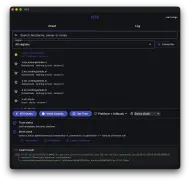
Want the GUI? #
The full Flutter showcase lives at
example/lib/main.dart and is invoked with an
explicit target:
# from the example directory
flutter run -t lib/main.dart

# from the repo root
flutter run -t example/lib/main.dart
A clock-mode selector beside the trust-mode dropdown picks what
Get Time runs: Legacy clock (NtsClient.getTime, anchored on
the best-effort MonotonicClock), Strict clock
(NtsClient.getTimeStrict on a resolved StrictClockContext, as in
the snippet above) or Compare clocks (both against the same
server, logged side by side). In the strict modes a panel shows the
context's provenance, source and generation, with Re-resolve,
Invalidate and Export reference actions. Under the mock bridge
the strict modes report the clock as unavailable, because
StrictClockContext.resolve refuses a mock. See the
GUI User Manual for details.
See example/README.md for the three entry points
(snippet, GUI, CLI) and the bridge-mode toggles.
Metadata

Documentation
Publisher
Weekly Downloads
Metadata
Authenticated network time for Flutter apps, secured by Network Time Security (NTS).
Repository (GitHub)
View/report issues
Contributing
Topics
#ntp #time #networking #security #cryptography
License
 MIT (license)
Dependencies
code_assets, flutter, flutter_rust_bridge, freezed_annotation, hooks, meta, native_toolchain_rust