
nav_bridge 3.0.1  nav_bridge: ^3.0.1 copied to clipboard
A router-agnostic navigation layer for Flutter with testable guards and progressive GoRouter migration.
Nav Bridge #





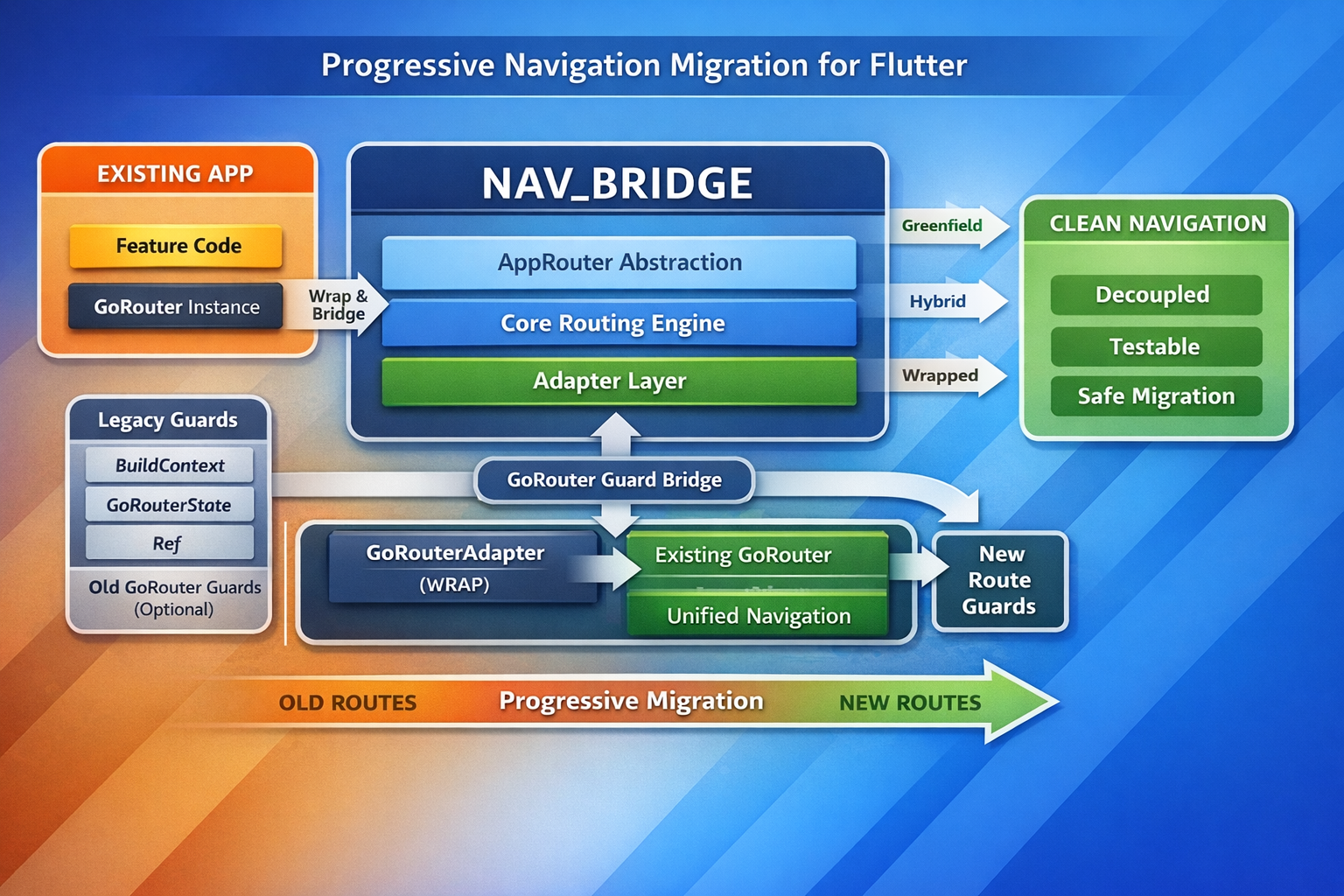
A progressive, router-agnostic navigation layer for Flutter that allows you to wrap existing GoRouter apps and migrate to a clean, testable, decoupled architecture — without rewriting your routes.
Why Nav Bridge? #
Flutter apps are usually tightly coupled to a routing library:
// ❌ Your business logic depends on GoRouter
context.go('/users/42');
context.push('/settings');
This creates several problems:
- Vendor lock-in: Business logic depends on GoRouter/AutoRoute
- Untestable: Navigation requires Flutter widgets
- Expensive migrations: Changing routers means rewriting navigation
- Tight coupling: UI and routing are inseparable
Nav Bridge solves this with a thin abstraction layer:
// ✅ Your app talks to AppRouter, not GoRouter
appRouter.goToUserProfile('42');
Key Features #
| Feature | Description |
|---|---|
| Wrap Mode | Use your existing GoRouter without any changes |
| Progressive Migration | Migrate one feature at a time, old & new coexist |
| Full DI Support | Riverpod Ref available in all guards |
| Guard Bridges | Keep existing guards working immediately |
| InMemoryAdapter | Unit test navigation without Flutter |
| Shell Navigation | Full StatefulShellRoute support |
Installation #
dependencies:
  nav_bridge: ^2.0.0
  go_router: ^15.0.0

  # Optional - for Riverpod guards
  flutter_riverpod: ^2.4.0
flutter pub get
Quick Start #
Step 1: Wrap Your Existing Router #
Zero changes to your existing code:
import 'package:nav_bridge/nav_bridge.dart';

// Your existing GoRouter (unchanged)
final goRouter = GoRouter(
  routes: [...],
  redirect: myRedirectLogic,
);

// Wrap it with Nav Bridge
final adapter = GoRouterAdapter.wrap(goRouter);

// Everything still works!
context.go('/profile/42');  // ✅ Still works
Step 2: Add Guards with DI Support #
final adapter = GoRouterAdapter.wrap(
  goRouter,
  additionalGuards: [AuthGuard(), RoleGuard()],
);

// Inject dependencies (Riverpod Ref, etc.)
adapter.contextBuilder = (state) => {
  'ref': ref,
  'goRouterState': state,
  'context': navigatorKey.currentContext,
};
Step 3: Create Type-Safe Navigation (Optional) #
abstract class AppRouter {
  Future<void> goToHome();
  Future<void> goToUserProfile(String userId);
}

class MyAppRouter implements AppRouter {
  final GoRouterAdapter _adapter;

  MyAppRouter(this._adapter);

  @override
  Future<void> goToUserProfile(String userId) =>
      _adapter.go('/profile/$userId');
}
Guards #
Modern Riverpod Guards #
class AuthGuard extends RiverpodRouteGuard {
  @override
  int get priority => 100;  // Higher = runs first

  @override
  List<String>? get excludes => ['/login', '/register'];

  @override
  Future<GuardResult> canActivateWithRef(
    GuardContext context,
    Ref ref,
  ) async {
    final isAuthenticated = ref.read(authProvider).isAuthenticated;

    if (!isAuthenticated) {
      return GuardResult.redirect('/login');
    }

    return GuardResult.allow();
  }
}
Bridge Existing Guards (Zero Rewrite) #
Already have guards? Bridge them without any changes:
// Your existing guard function
FutureOr<GuardResult> myExistingGuard(
  BuildContext context,
  GoRouterState state,
  Ref ref,
) async {
  // Your existing logic...
}

// Bridge it - zero changes needed!
final bridgedGuard = GoRouterGuardBridge(myExistingGuard);
Guard Result Types #
sealed class GuardResult {
  // Allow navigation
  static GuardAllow allow();

  // Redirect to another path
  static GuardRedirect redirect(String path, {Map<String, dynamic>? extra});

  // Block navigation
  static GuardReject reject({String? reason});
}
Unit Testing #
Test navigation without Flutter widgets:
void main() {
  group('Navigation', () {
    test('authenticated user can access profile', () async {
      final router = InMemoryAdapter(
        guards: [MockAuthGuard(isAuthenticated: true)],
      );

      await router.go('/profile/42');

      expect(router.currentLocation, '/profile/42');
    });

    test('unauthenticated user is redirected to login', () async {
      final router = InMemoryAdapter(
        guards: [MockAuthGuard(isAuthenticated: false)],
      );

      await router.go('/profile/42');

      expect(router.currentLocation, '/login');
    });

    test('tracks navigation history', () async {
      final router = InMemoryAdapter();

      await router.go('/');
      await router.push('/profile/42');
      await router.push('/settings');

      expect(router.navigationHistory, ['/', '/profile/42', '/settings']);

      router.pop();
      expect(router.currentLocation, '/profile/42');
    });
  });
}
Progressive Migration Guide #
Phase 1: Wrap (Day 1) #
// Just wrap, nothing else changes
final adapter = GoRouterAdapter.wrap(existingRouter);
Phase 2: Bridge Guards (Week 1) #
// Bridge existing guards
final bridged = GoRouterGuardBridge(existingGuard);
Phase 3: Add AppRouter (Week 2) #
// Create type-safe navigation
abstract class AppRouter {
  Future<void> goToProfile(String id);
}
Phase 4: Migrate Features (Ongoing) #
// Old and new coexist
context.go('/old');           // Old code ✅
appRouter.goToProfile('42');  // New code ✅
Architecture #
┌─────────────────────────────────────────────────────────┐
│                    Feature Code                          │
│              (Uses AppRouter interface)                  │
└─────────────────────────┬───────────────────────────────┘
                          │
                          ▼
┌─────────────────────────────────────────────────────────┐
│                     AppRouter                            │
│            (Your type-safe abstraction)                  │
└─────────────────────────┬───────────────────────────────┘
                          │
                          ▼
┌─────────────────────────────────────────────────────────┐
│                     Nav Bridge                           │
│         (Guards, DI, Navigation abstraction)             │
└─────────────────────────┬───────────────────────────────┘
                          │
                          ▼
┌─────────────────────────────────────────────────────────┐
│              GoRouterAdapter.wrap()                      │
│            (Wraps your existing router)                  │
└─────────────────────────┬───────────────────────────────┘
                          │
                          ▼
┌─────────────────────────────────────────────────────────┐
│              Your Existing GoRouter                      │
│          (Routes, Shell, everything intact)              │
└─────────────────────────────────────────────────────────┘
API Reference #
Adapters #
| Adapter | Use Case |
|---|---|
GoRouterAdapter.wrap() |
Existing GoRouter apps (recommended) |
GoRouterAdapter.create() |
New applications |
GoRouterAdapter.withGuards() |
New with integrated guard system |
InMemoryAdapter |
Unit testing |
Guards #
| Class | Description |
|---|---|
RouteGuard |
Base class for all guards |
RiverpodRouteGuard |
Guard with Riverpod Ref access |
GoRouterGuardBridge |
Bridge for existing guards with Ref |
SimpleGoRouterGuardBridge |
Bridge for guards without Ref |
GoRouterRedirectBridge |
Bridge for redirect functions |
CompositeGuard |
Combine guards with AND logic |
AnyGuard |
Combine guards with OR logic |
Core Classes #
| Class | Description |
|---|---|
GuardContext |
Context passed to guards with DI support |
GuardResult |
Sealed class: Allow, Redirect, Reject |
RouteDefinition |
Router-agnostic route definition |
ShellRouteDefinition |
Shell/tab navigation support |
Roadmap #
- ✅ GoRouter wrap mode
- ✅ Riverpod guard support
- ✅ Guard bridge adapters
- ✅ InMemoryAdapter for testing
- ✅ Shell navigation support
- ❌ AutoRoute adapter
- ❌ Beamer adapter
- ❌ Typed route code generation
- ❌ Analytics observers
- ❌ Transition abstraction
When Should You Use This? #
| Scenario | Recommendation |
|---|---|
| Existing GoRouter app | Perfect fit |
| Large team / enterprise | Highly recommended |
| Need navigation unit tests | Essential |
| Planning router migration | Future-proof |
| Small personal app | Optional |
Community #
Contributing #
Contributions are welcome! Please read our Contributing Guide first.
# Clone the repo
git clone https://github.com/chekarhamza88-stack/nav_bridge.git

# Install dependencies
flutter pub get

# Run tests
flutter test

# Check analysis
flutter analyze
License #
MIT License - see LICENSE for details.
Nav Bridge doesn't replace GoRouter.
It makes GoRouter testable, replaceable, decoupled, and enterprise-ready.
Made with love by chekarhamza88-stack
Metadata

Publisher
unverified uploader
Weekly Downloads
Metadata
A router-agnostic navigation layer for Flutter with testable guards and progressive GoRouter migration.
Repository (GitHub)
View/report issues
Contributing
Topics
#navigation #routing #go-router #architecture #testing
Documentation
Funding
Consider supporting this project:
github.com
License
 MIT (license)

