
constellation_particles 1.1.0  constellation_particles: ^1.1.0 copied to clipboard
 developeryusuf.com
Pointer-reactive constellation particle background for Flutter. Honours reduced motion and high contrast, pauses when backgrounded, zero runtime deps.
constellation_particles #
Decorative motion is the first thing a reader turns off, and a particle background that never asks keeps drifting anyway. This one holds still when the platform requests reduced motion, and leaves the constellation on screen while it does.
example/lib/main.dart puts that request behind a switch: flip it and the
points stop where they are, with the constellation still on screen.

Why this instead of what you already have #
Instead of a bare CustomPainter. It is an abstract class whose contract
is one method, paint(Canvas, Size) (rendering/custom_paint.dart:149), and
whose semanticsBuilder returns null until you write one
(rendering/custom_paint.dart:222). It hands you a canvas. Reduced motion,
high contrast, pausing when the app goes to the background, and keeping the
decoration out of the accessibility tree are all left to you.
Instead of the existing particle packages. animated_background,
particle_field and particles_network are genuinely animated packages, but a
case-insensitive search of each one's lib/ finds no disableAnimations, no
highContrast, no AppLifecycleState and no Semantics. This package reads
MediaQuery.maybeDisableAnimationsOf and holds the field still with the
constellation on screen (lib/constellation_particles.dart:138), and stops the
clock when the app is hidden (lib/constellation_particles.dart:164). To be
fair about scale, all three draw under 4,000 downloads a month, so this is a
small corner of the ecosystem.
Reach for it when #
- A landing or sign-in screen wants a moving background that stops when the platform asks for reduced motion.
- The background must stop spending frames once the app is backgrounded.
- Screen readers should pass over the decoration instead of announcing it.
Skip it if a still gradient or image would do the job: even with those pauses, this runs a simulation every frame while motion is allowed, and a static background costs nothing.
Neighbour lookups run through a spatial hash grid: a particle's work is set by how crowded its own neighbourhood is rather than by how many particles exist.
Install #
flutter pub add constellation_particles
Use it #
Drop it into a Stack behind your content and give it a bounded size.
Stack(
  children: [
    const Positioned.fill(child: ConstellationParticles()),
    yourContent,
  ],
)
Tune it #
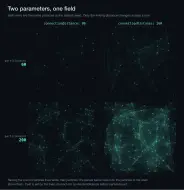
Two parameters decide how the field reads. particleCount sets how many points
there are, and connectionDistance sets how far apart two of them can be and
still be joined.
ConstellationParticles(
  particleCount: 60,
  connectionDistance: 80,
  color: const Color(0xFF64FFDA),
)

Reach for connectionDistance before particleCount. The GPU draws one line
per link rather than one per particle, and raising the count multiplies links
quadratically: at the default distance, 400 particles is 3,563 links and 800 is
13,611.
What the grid costs #
Connecting-line fields usually decide which pairs to join by measuring every particle against every other one. This one buckets particles into a grid whose cell size equals the connection distance, which leaves a particle able to reach only its own cell and the eight around it.

The result splits in two, and only one half flatters the grid. On a canvas that stays one size it removes about eight distance checks in nine and still runs slower, because nine hash-map lookups per particle cost more than the arithmetic they replaced. On a canvas that grows with the count the exponent changes instead of the constant, and there the grid pass came out roughly five times faster at 6400 particles.
Either way, at a few hundred particles on a normal window both passes take
microseconds. example/frame_cost.dart produces every number above, and
example/README.md has the tables, the hardware they were measured on, and the
AOT run that a Flutter release build actually uses.
What it will not do #
- It paints a background. No API attaches particles to widgets, emits them from a point, or reacts to the content in front of them.
- Touch is inert until you pass
touchReactive: true. A field that grabbed pointers by default would swallow drags meant for your UI. particleCountis a request. High-contrast mode halves it.- The measurements above cover the neighbour pass and nothing else. Whether the pass or the drawing is what costs you a frame is a question for a Flutter timeline.
Alternatives #
animated_background (311 likes), particle_field (143) and
particles_network (66) are all older and more widely used than this package.
Reading their published archives on 2026-08-09, none of the three mentions
disableAnimations, highContrast or AppLifecycleState anywhere, and none
puts a node into the semantics tree. Closing that gap is why this package was
written.
If you have accessibility covered elsewhere, particles_network is the one
worth looking at. Of the three it is the only one that avoids the all-pairs
scan, using a quadtree where this package uses a grid.
Parameters #
| Parameter | Default | Description |
|---|---|---|
particleCount |
100 |
Particles at full density; halved under high contrast. |
color |
0xFF64FFDA |
Base colour; per-particle/line opacity derived from it. |
speed |
1.0 |
Drift-speed multiplier. |
connectionDistance |
120.0 |
Max link distance, also the grid cell size. |
repulsionRadius |
200.0 |
Pointer influence radius. |
repulsionForce |
50.0 |
Pointer push strength. |
seed |
42 |
Layout seed; fixed by default for reproducible fields. |
touchReactive |
false |
Let touches drive repulsion too, as well as the mouse. |
The mouse drives repulsion on desktop and web with no configuration. Set
touchReactive: true when the particles are a foreground surface and you want
touches to push them around as well.
What else it handles #
- Pauses its ticker when the app is hidden or backgrounded.
- Halves the particle count when the platform requests high contrast.
- Caches its paints and the glow gradient, and repaints only after the simulation has actually advanced.
- Excludes itself from the semantics tree, being decoration.
- Renders inside a
RepaintBoundary; your content stays out of its repaints.
License #
MIT © Yusuf İhsan Görgel
Metadata

Documentation
Publisher
Weekly Downloads
Metadata
Pointer-reactive constellation particle background for Flutter. Honours reduced motion and high contrast, pauses when backgrounded, zero runtime deps.
Repository (GitHub)
View/report issues
Topics
#animation #particles #canvas #background #custompainter
License
 MIT (license)