
blake3_ffi 1.2.2  blake3_ffi: ^1.2.2 copied to clipboard
 developeryusuf.com
BLAKE3 hashing for Dart over native FFI: 22x the throughput of the pure-Dart path on bulk data. One-shot, streaming, keyed (MAC), key derivation. C compiled at build.
blake3_ffi #
Fast BLAKE3 cryptographic hashing for Dart, backed by the official BLAKE3 C implementation over FFI. The native code is compiled automatically at build time through Dart build hooks; there is nothing to install and no prebuilt binary to ship.

Why this instead of what you already have #
Instead of package:crypto or hashlib. Neither implements BLAKE3.
Grepping the installed sources for blake3 returns nothing in either one; the
same grep for blake2 returns ten files in hashlib, including
lib/src/blake2s.dart and lib/src/blake2b.dart, so the search itself works.
hashlib is the strongest pure-Dart hashing package on pub.dev at 160/160
points, and it still stops at BLAKE2.
Instead of blake3_dart. It does implement BLAKE3 in pure Dart, with
keyed mode and key derivation, so this is not a capability gap. Two things
differ. Its library file exports six whole-buffer functions and nothing else
(lib/blake3_dart.dart); the HashContext class that holds update and
finalize sits at lib/src/blake3_compact.dart:187 and is not exported, so a
caller has to hold an entire file in memory as one Uint8List. This package
exports Blake3Hasher (lib/src/hasher.dart:36) and blake3Stream
(lib/src/functions.dart:117). On identical buffers, with digests
cross-checked between the two implementations, bench/bench.dart measures
2318 MB/s against 102 at 1 MiB.
Reach for it when
- You hash large files or streams and SHA-256 is the bottleneck you measured.
- You want a MAC and a KDF from the same primitive without a second dependency.
- You checksum build artifacts or uploads from a server or CLI.
Skip it if you need SHA-256 for interoperability or compliance, or you are
shipping to mobile or web: pubspec.yaml declares Linux, macOS, and Windows
only.
- One-shot hashing of a byte buffer.
- Incremental (streaming) hashing for data that arrives in pieces or does
not fit in memory, either through
Blake3Hasheror the one-callblake3Streamover aStream<List<int>>. - Keyed hashing (a MAC / PRF) and key derivation (KDF).
- Extendable output (XOF): request any number of output bytes.
Dart also has a pure-Dart BLAKE3. On a 16 MiB buffer this package ran at 22x its throughput, for the same digest, and gave up everything but the Dart VM on desktop to get there: no web, and no Flutter yet on any platform. Which one to take.
import 'dart:convert';
import 'package:blake3_ffi/blake3_ffi.dart';

void main() {
  // One-shot, as a hex string.
  print(blake3Hex(utf8.encode('hello')));

  // Streaming: feed chunks, then finalize.
  final hasher = Blake3Hasher();
  try {
    hasher.update(utf8.encode('hel'));
    hasher.update(utf8.encode('lo'));
    final digest = hasher.finalize(); // Uint8List, 32 bytes.
    print(digest.length);
  } finally {
    hasher.dispose();
  }
}
Hashing a file or stream #
To hash something too large to load at once, pass its byte stream to
blake3Stream (or blake3StreamHex). It drives a Blake3Hasher for you and
disposes it when the stream ends, so the input is never held in memory all at
once:
import 'dart:io';
import 'package:blake3_ffi/blake3_ffi.dart';

Future<String> hashFile(String path) =>
    blake3StreamHex(File(path).openRead());
This is the same job as binding a Stream to a crypto SHA-256 sink, but it
runs at BLAKE3's throughput, which is where the win over SHA-256 is largest (see
below).
What BLAKE3 is, and why native #
BLAKE3 is a modern cryptographic hash function. It is a tree hash: a single input is split into chunks that can be compressed independently. On top of that, its compression function maps cleanly onto SIMD instructions, which lets one core hash several chunks at once. Those instructions are what a pure-Dart implementation cannot reach, and that is where the throughput gap on bulk data comes from. This package compiles the reference C implementation and, on arm64, its NEON kernel.
BLAKE3 is not a password hash. For passwords use a memory-hard function (Argon2, scrypt). BLAKE3 is for content addressing, deduplication, integrity checks, MACs, and key derivation.
Which BLAKE3 package #
Dart has two. blake3_dart is pure Dart: no toolchain, and it
runs everywhere Dart does, web and Flutter mobile included. This package
compiles the reference C instead. That buys throughput and costs reach: it
needs a C compiler at build time and targets Linux, macOS and Windows on the
Dart VM. Flutter is out on every platform until build hooks are stable there.
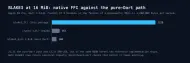
At 16 MiB on an Apple M4 Pro, this package hashed 2226 MB/s against 100 MB/s for
the pure-Dart path (blake3_dart 1.0.0): a factor of 22. Both return the same
digest, and bench/bench.dart verifies that before it times anything.
Take the pure-Dart package if you need web, mobile, or any Flutter app today, or if a build-time C toolchain is not something you want in your pipeline. Take this one for bulk hashing on desktop and server, where that gap is the whole point.
Performance, honestly #
bench/bench.dart measures, and writes doc/benchmark.json. The two tables
below are written from that file by tool/readme_tables.dart, and the chart by
tool/benchmark_svg.dart. test/published_numbers_test.dart compares the
generated block against a fresh render, and looks for the headline figures
wherever they are still typed by hand: the opening paragraph, "Which BLAKE3
package", the pubspec description and screenshot caption, and
doc/benchmark.svg. Your own numbers will differ by machine and architecture;
run the benchmark on your data before drawing conclusions.


Measured on Apple M4 Pro, macOS 26.3 (Build 25D125), Dart 3.11.0, against blake3_dart 1.0.0 and crypto 3.0.7. Each figure is the fastest of 5 batches in the fastest of 3 placements. Input sizes are powers of two, so 1 MiB is 1,048,576 bytes; throughput is decimal, so 1 MB/s is 1,000,000 bytes per second.
Bulk throughput, MB/s:
| Input | this package | blake3_dart 1.0.0 | crypto 3.0.7 SHA-256 | vs pure Dart | vs SHA-256 |
|---|---|---|---|---|---|
| 1 MiB | 2221 | 100 | 166 | 22.2x | 13.4x |
| 16 MiB | 2226 | 100 | 167 | 22.2x | 13.3x |
| 64 MiB | 2253 | 101 | 167 | 22.2x | 13.5x |
Small inputs, microseconds per call including FFI overhead:
| Input | this package | blake3_dart 1.0.0 | crypto 3.0.7 SHA-256 | vs pure Dart | vs SHA-256 |
|---|---|---|---|---|---|
| 64 B | 0.19 | 0.67 | 0.88 | 3.5x | 4.6x |
| 256 B | 0.33 | 2.47 | 2.02 | 7.5x | 6.1x |
| 1 KiB | 0.94 | 9.59 | 6.57 | 10.2x | 7.0x |
| 4 KiB | 2.01 | 40.14 | 24.86 | 20.0x | 12.4x |
Bulk throughput is flat from 1 MiB up. The 64-byte row is an upper bound on what a call costs before any hashing happens, and a 1 MiB call costs three orders of magnitude more. These rows measure the kernel rather than the call.
There is no small-input crossover where the FFI call cost takes the win back: even at 64 bytes, where that cost is most of the work, the native path stays ahead. The margin then widens with size, which is where the SIMD tree hashing pays off.
Two caveats. Ordering barely mattered here: the spread across the three
placements was under 0.6% at 16 MiB, and doc/benchmark.json records it per
row. Absolute throughput still tracks machine state, which makes the ratios the
durable part. And this is one arm64 machine, where the NEON kernel is compiled
in; on x86-64 the portable C kernel runs instead (see
Platform support) and these figures do not carry over.
Keyed hashing and key derivation #
Keyed mode turns BLAKE3 into a MAC or PRF. The key must be exactly 32 bytes.
final key = Uint8List(32); // a real, secret 32-byte key
final tag = blake3Keyed(key, utf8.encode('message'));
Key-derivation mode produces subkeys from input keying material, separated by a hardcoded context string. The context should be application-specific and globally unique; do not let it be attacker-controlled.
final subkey = blake3DeriveKey(
  'example.com 2026 session cookie v1',
  masterSecret,
);
Both modes are also available on Blake3Hasher for streaming input:
Blake3Hasher.keyed(key) and Blake3Hasher.deriveKey(context).
Extendable output (XOF) #
BLAKE3 produces an unbounded output stream; the default 32 bytes are just
its start. Pass outputLength for more, and seek to skip into the
stream. Extending never changes earlier bytes.
final long = blake3(data, outputLength: 64);   // 64 bytes
final tail = Blake3Hasher()
  ..update(data);
// tail.finalize(seek: 32, outputLength: 32) == long bytes 32..63
example/xof.dart runs that comparison and checks it over every byte, then
reads a cipher key, a MAC key and a short key id out of one derive-key pass.
Dropping into code that takes a Hash #
blake3(bytes) is the direct way to hash here and it stays the shortest one.
The case this section is about is different: code you did not write that takes
a package:crypto Hash, such as a checksum helper, a content-addressed cache
or an Hmac. blake3Hash is BLAKE3 wearing that interface, which lets those
call sites change algorithm without changing shape.
import 'package:blake3_ffi/blake3_ffi.dart';
import 'package:crypto/crypto.dart';

Digest checksum(List<int> bytes, {Hash algorithm = sha256}) =>
    algorithm.convert(bytes);

checksum(bytes, algorithm: blake3Hash); // same function, faster hash
It behaves the way the interface expects: blockSize is 64, the same as
SHA-256, which is what Hmac needs to pad correctly; startChunkedConversion
streams through a Blake3Hasher and releases it on close; and one-shot
convert skips the sink entirely. Digest holds 32 bytes, which is BLAKE3's
default; for the longer outputs BLAKE3 can produce, call blake3 with
outputLength instead.
The digest is the same either way, and a test pins that: if the Hash view and
blake3() ever disagreed, the view would quietly be a different algorithm.
API notes #
finalize()does not consume the hasher: you may keep callingupdateandfinalize, andreset()returns it to its initial state (keeping the key/mode) so one hasher can hash many independent inputs.dispose()frees the small native hasher buffer. A finalizer also frees forgotten hashers at garbage collection, but that memory is invisible to the Dart heap, so prefer explicit disposal. Using a hasher afterdispose()throwsStateError.- Digests are returned as
Uint8List;blake3Hexreturns lowercase hex.
Shipping a standalone binary #
dart compile exe does not run build hooks, so a program that depends on this
package stops before it starts:
$ dart compile exe bin/my_cli.dart
'dart compile' does not support build hooks, use 'dart build' instead.
dart build cli runs the hook and lays the pieces out for you:
$ dart build cli
Generated: build/cli/<os>_<arch>/bundle/bin/my_cli
$ ls build/cli/macos_arm64/bundle/*
bin/  my_cli
lib/  libblake3_ffi.dylib
Ship the whole bundle/ directory. The executable resolves its library through
a relative ../lib path, so a copy of the binary on its own fails at the first
call:
Failed to load dynamic library '../lib/libblake3_ffi.dylib'
dart build cli takes no positional target. With one file under bin/ the bare
command is enough; with more than one, pass -t. dart run and dart test are
unaffected, since both run the hook already. The command is marked preview in
Dart 3.11.
Platform support #
Requires Dart 3.10+ with build hooks (dart run, dart test, and
dart build compile the C automatically; a C toolchain must be present:
Xcode CLT, gcc/clang, or MSVC).
Supported platforms are the desktop targets the pubspec declares: Linux, macOS, and Windows on the Dart VM. The rows below describe which CPU architecture uses which kernel, not additional platforms.
| Architecture | Kernel in this release | Status |
|---|---|---|
| arm64 (macOS, Linux) | NEON SIMD | Developed and tested on macOS arm64; CI covers macOS arm64 |
| x86-64 (Linux, macOS, Windows) | Portable C | Correct (passes the official vectors); CI covers Linux and Windows x64 |
Correctness is identical on both paths: every target passes the official
BLAKE3 test vectors. The difference is throughput. The x86-64 SIMD kernels
(SSE2/SSE4.1/AVX2/AVX512) are vendored in src/third_party/blake3/ but not
yet compiled, because they need per-source compiler flags the build system
cannot express per file today; enabling them is planned for a later
release. There is no Flutter, iOS, or Android support yet; it arrives when
build hooks land in stable Flutter.
Correctness #
The package is verified against the official BLAKE3 test vectors: all 35 cases, in the default, keyed, and derive-key modes, checking both the 32-byte digest and the extended (131-byte) output, plus streaming-equals-one-shot for every case. Correctness is the reason this package exists; if a vector did not match, there would be no package.
Credits and licenses #
This package is MIT licensed (see LICENSE). It vendors the official
BLAKE3 C implementation (version
1.8.5), which is released into the public domain via CC0 1.0 or, at your
option, under Apache 2.0. The upstream license texts and a NOTICE are in
src/third_party/blake3/. BLAKE3 was designed by Jack O'Connor, Jean-Philippe
Aumasson, Samuel Neves, and Zooko Wilcox-O'Hearn.
Metadata

Documentation
Publisher
Weekly Downloads
Metadata
BLAKE3 hashing for Dart over native FFI: 22x the throughput of the pure-Dart path on bulk data. One-shot, streaming, keyed (MAC), key derivation. C compiled at build.
Repository (GitHub)
View/report issues
Topics
#blake3 #hashing #cryptography #ffi #performance
License
 MIT (license)
Dependencies
code_assets, crypto, ffi, hooks, native_toolchain_c