
aug_validateform 0.0.1-dev.4  aug_validateform: ^0.0.1-dev.4 copied to clipboard
A zero-boilerplate, type-safe validation engine for Flutter that weaves reactive logic directly into models using Dart Augmentations. Wasm-compatible and Impeller-ready.
aug_validateform #



aug_validateform is a zero-boilerplate, type-safe validation engine that weaves logic directly into your models using the stable Augmentation pattern. Unlike traditional form builders, it preserves your pure data models while providing reactive ValueNotifier feedback with zero reflective overhead.
The Problem & The Solution #
In modern Flutter development, complex forms often lead to a "Maintenance Nightmare." aug_validateform solves this by moving logic out of the UI and into a generated, high-performance validation layer.
| Feature | The Legacy Reality | The aug_validateform Way |
|---|---|---|
| Type Safety | String-keyed maps or dynamic fields | Fully type-safe model signatures |
| State Management | Manual setState or controller hacks |
Auto-generated ValueNotifier state |
| Boilerplate | 50+ lines of validator logic in UI | High-density field annotations |
| Performance | Runtime reflection or heavy wrappers | Native Augmentation injection (Wasm-Ready) |
Reactive Validation in Action #
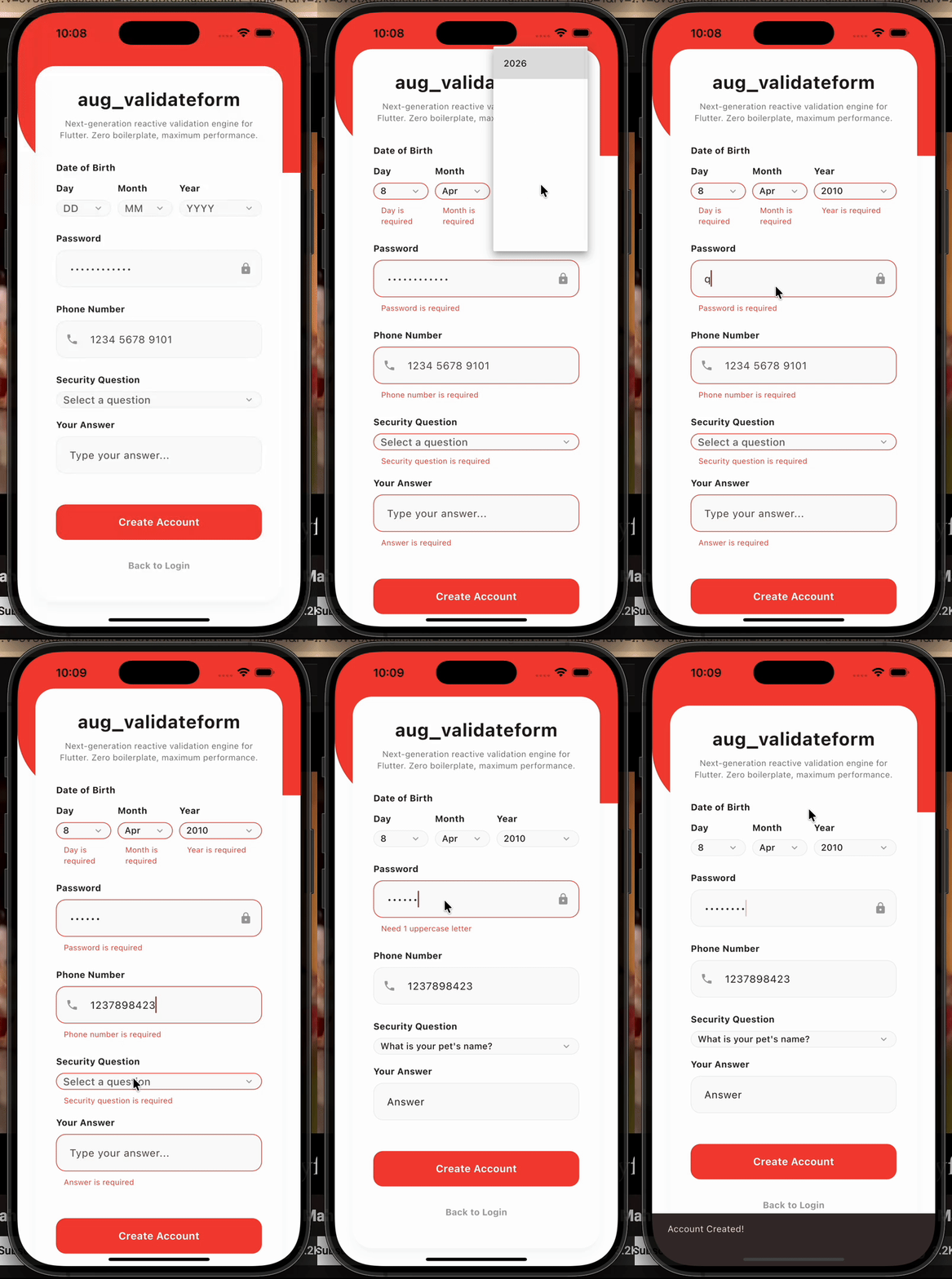
Architectural Transparency #
How does it work? Unlike legacy generators that rely on messy mixins or slow reflection, aug_validateform uses the Dart Augmentation Library standard.
When you run build_runner, the engine doesn't just create a separate file; it "augments" your existing class. By using the augment class keyword, I inject the validationNotifier and validate() methods directly into your model. This approach is 100% Wasm-compatible and preserves a clean class hierarchy—no with _$Mixin required.
Quick Start #
Step 1: pubspec.yaml Setup #
Add the core and the generator to your project:
dependencies:
  aug_validateform: latest_version

dev_dependencies:
  aug_validateform_generator: latest_version
  build_runner: ^2.4.0
Step 2: Define Your Validation Model #
Annotate your class and let the engine augment it with validation powers.
import 'package:aug_validateform/aug_validateform.dart';
import 'package:flutter/foundation.dart';

import 'user_form.validate.dart'; // Source generation handles the rest

@Validatable()
class UserForm {
  @Required(message: "Email is required")
  @Email()
  String email = "";

  @Required()
  @MinLength(8)
  @UpperCase()
  @Digit()
  @SpecialChar()
  String password = "";

  @Match('password', message: "Passwords do not match")
  String confirmPassword = "";
}
Step 3: Run the Engine #
Generate the performance-optimized code:
dart run build_runner build --delete-conflicting-outputs
Step 4: Reactive UI Integration #
Observe errors with surgically precise rebuilds using ValidationWatcher.
ValidationWatcher(
  notifier: form.validationNotifier,
  fieldName: 'email',
  builder: (context, error) => TextFormField(
    onChanged: (v) => form.email = v,
    decoration: InputDecoration(
      labelText: 'Email Address',
      errorText: error,
    ),
  ),
);
Validator Reference #
The validator suite is built for modern security and format requirements.
| Annotation | Description | Parameters |
|---|---|---|
@Required |
Checks for null or empty strings | message |
@Email |
Validates standard email formats | message |
@Phone |
Validates international phone formats | message |
@Alphanumeric |
Letters and numbers only | message |
@UpperCase |
Requires at least one capital letter | message |
@LowerCase |
Requires at least one small letter | message |
@Digit |
Requires at least one numerical digit | message |
@SpecialChar |
Requires at least one symbol | message |
@MinLength |
Enforces minimum string length | length, message |
@MaxLength |
Enforces maximum string length | length, message |
@Match |
Cross-field comparison logic | fieldName, message |
@Combined... |
Logical OR (Email or Phone) | message |
Community & Contributing #
I welcome contributions! If you find a bug or have a feature request, please open an issue on the GitHub repository.
Meet the Author #
Developed and maintained by Muhammad Omar.
- LinkedIn: muhammad-omar-0335
- GitHub: umarKhan1
License #
This project is licensed under the MIT License - see the LICENSE file for details.
Metadata
Publisher
unverified uploader
Weekly Downloads
Metadata
A zero-boilerplate, type-safe validation engine for Flutter that weaves reactive logic directly into models using Dart Augmentations. Wasm-compatible and Impeller-ready.
Homepage
Repository (GitHub)
View/report issues
License
 unknown (license)

